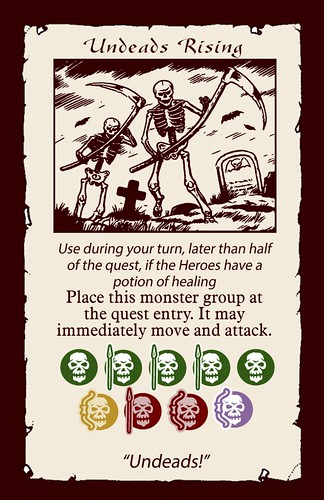
Anderas wrote:After testing, i found that the EWP deck was heavily changing the balance... maybe i took too many cards!
I was taking a card each time it was Morcar's turn, and no Monster on the board. Basically, every round.
Maybe this should be reformulated to "Each time there was No monster on the board for the entire round"
Just my thought...
Did you include a limit on the number of cards you could hold at any one time?
What is the average effect level per card in the deck you played?
How many turns does the average Quest take?
Let me lay out a hypothetical example. Take a Quest with a QSC value of 15, which the Heroes manage to play through in 25 rounds. Given your description above, we could say you drew 20 cards over the course of the game. If every card created a Spear trap, those 20 cards would add 10 Body Points of damage to the Quest by themselves!
To make the deck work properly, you have to break down the objectives you want to achieve through its use: What part of the Heroes' behavior are you trying to alter? How dangerous is each card on average? An EWP deck is usually designed to discourage player loitering - thus, the trigger for the EWP to draw a card must be quantifiably related to loitering actions. I would suggest a threefold condition:
- There must be no monsters on the board at the start of Zargon's turn.
- The Heroes must not have attacked any monsters since Zargon's last turn.
- No new doors may have been opened since Zargon's last turn.
Then there's the effect of the cards themselves. Let's suppose for a moment that Zargon draws 10 cards over the course of the average Quest. If the average effect of each card is similar to that of a Spear trap - i.e. 0.5 Body Points of damage - then those cards will add 5 to the Quest's QSC value, which can bump a medium-difficulty Quest up into the hard category, or make an already-hard Quest outright fatal to one or more Heroes. Complicating things further is the fact that you allow cards to be discarded to activate monster special abilities, which increases the value of every card to the maximum of its own printed value or the value of any on-board monster's special ability. Probably some of the more powerful effects should cost two cards to activate. I think it's the same way in Advanced HeroQuest, which gives the EWP some Chaos tokens as time passes, but if memory serves (which it doesn't always) requires multiple tokens to be discarded to activate certain effects.
I've never played with an Evil Wizard Deck, so I can't offer any more concrete advice on the subject. But if you keep a hand limit of 4-5 cards and limit your opportunities to draw new ones, the overall impact of the deck should remain low enough not to unbalance things overmuch.








 ...
...